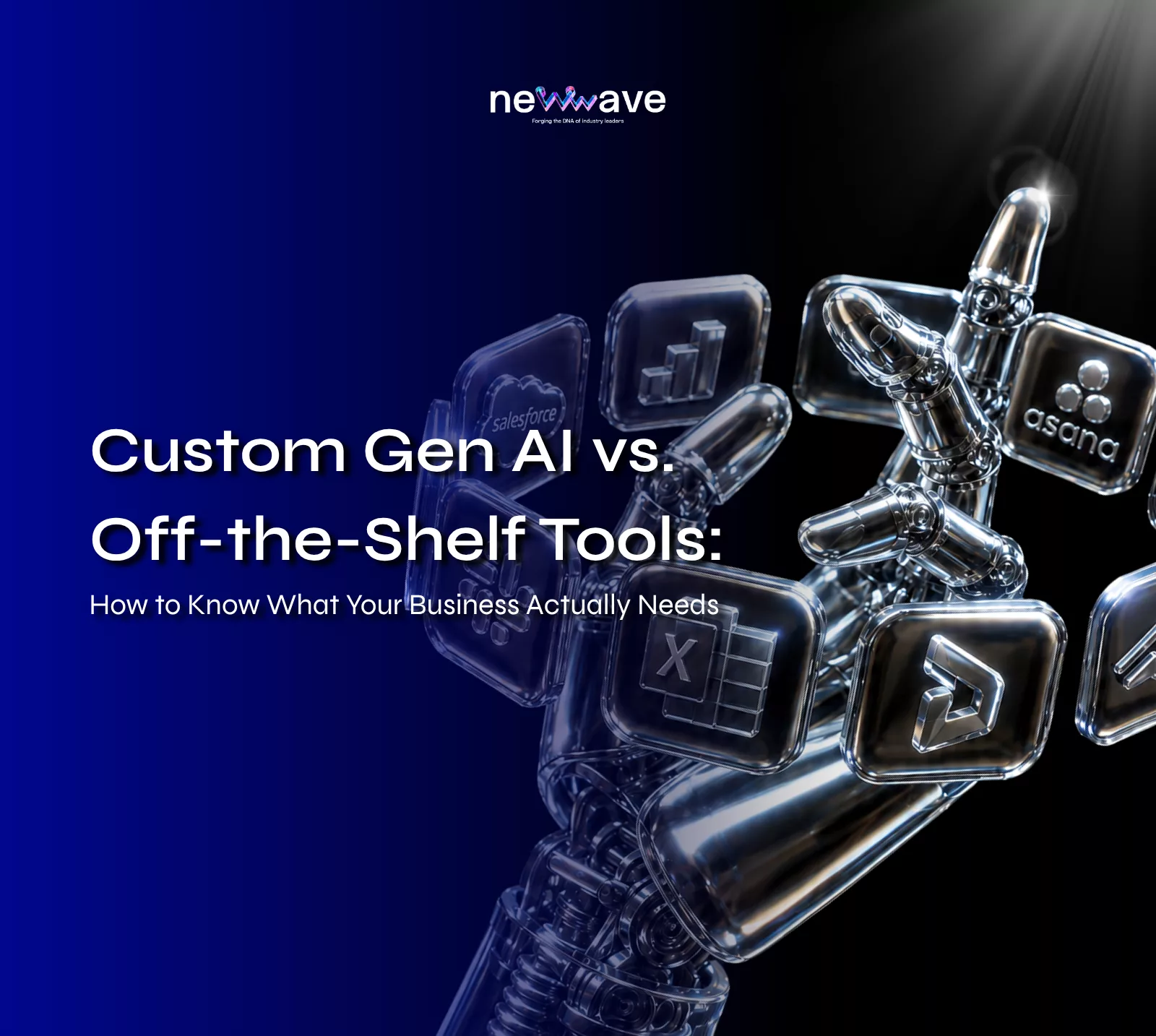
Almost every business owner has now tried an off-the-shelf AI tool. You've pasted a prompt into ChatGPT, generated a caption, maybe drafted a proposal. It felt like magic for about a week. Then the cracks showed: the tone was never quite yours, it didn't know your products, and every task started almost from zero, re-explaining your business again and again.
That gap between a generic tool and something built for you is exactly what this piece is about. Off-the-shelf AI is a starting line, not a finish line. Custom generative AI is what happens when the intelligence is trained on your business, speaks in your voice, and produces work you can actually ship. Below is a straight comparison, a simple way to decide which one you need, and the real outcomes custom generative AI delivers.
What is custom generative AI, and how is it different from a generic AI tool?
Generative AI creates new things: text, images, video, code, rather than just sorting or routing information. A generic AI tool does this for everyone in general. Custom generative AI does it for your business specifically.
The difference isn't the underlying model. It's the context. A custom solution is trained and grounded on your catalog, your brand voice, your past proposals, your customer language, and your rules for what "on-brand" means. So instead of a clever assistant that knows a little about everything, you get a system that knows your business deeply and produces output that's ready to use, not ready to be heavily edited.
Think of the off-the-shelf tool (ChatGPT, Gemini, DeepSeek) as a talented freelancer you re-brief every single morning. Custom generative AI is the in-house specialist who already knows the brand book, the product line, and how you like things done.
Generic vs. Custom: a side-by-side comparison
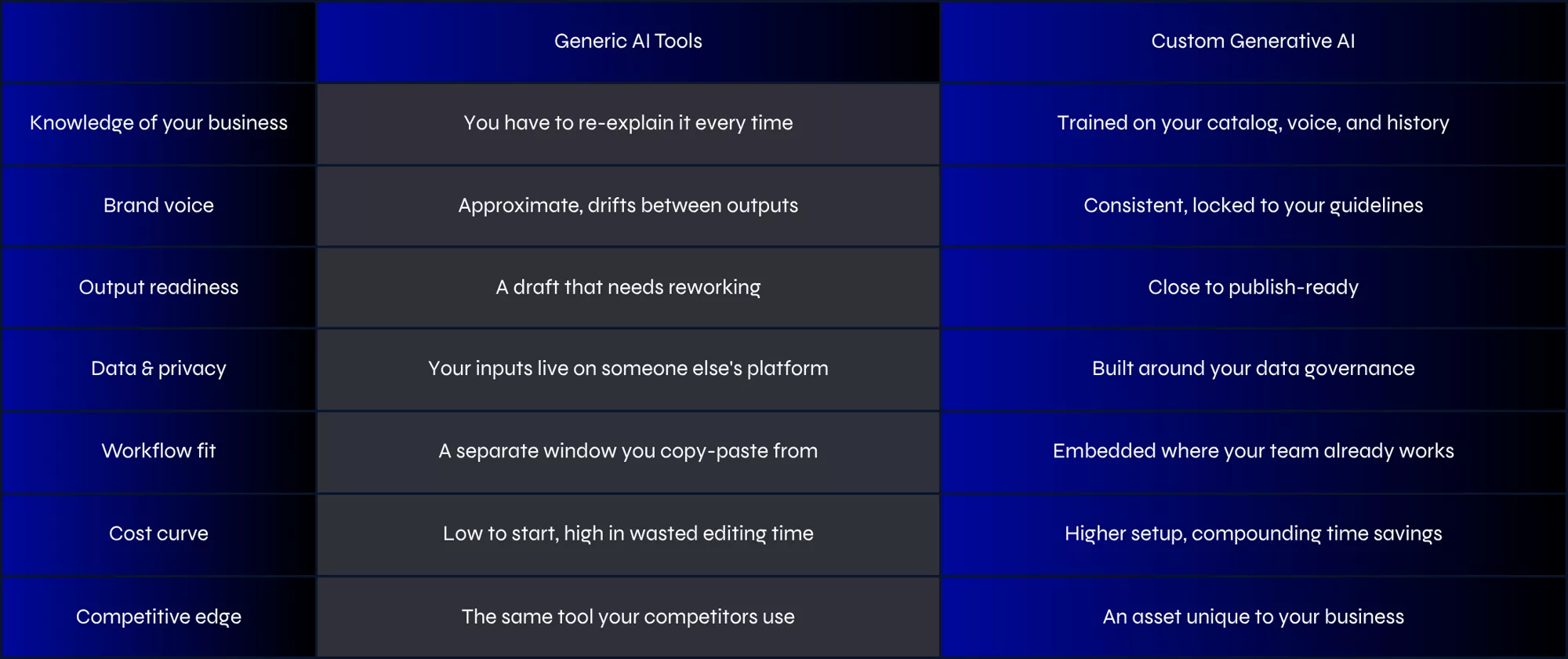
The pattern is clear. Generic AI wins on speed-to-first-try. Custom wins on everything that matters once AI becomes part of how you actually operate.
Is off-the-shelf AI ever enough?
Only in one situation: when you're not really running a business on it. A generic tool does the job for a student, a hobbyist, or anyone using AI for the occasional one-off, a quick brainstorm, a rough draft, a task where brand, privacy, and consistency simply don't matter and no one else sees the output.
The moment you're a company, that calculation flips almost entirely. You have a brand to protect, customers who expect consistency, sensitive data you can't paste into a public tool, and work that repeats every single day. At that point a business is overwhelmingly better off with custom generative AI. Off-the-shelf tool will keep feeling almost right and "almost right," repeated across every caption, proposal, and customer reply, is exactly what quietly drains your time, your consistency, and your edge. If you run a real business, the honest answer is that a generic tool is a stopgap, not a solution.
When does a business need custom generative AI?
The signs are consistent across the SMEs we work with: